My name is Vince Foster, and I’m a show designer who’s been in the live entertainment industry since 1979. I was at school at the time. In 1978, I went to see Genesis at a festival at Knebworth House, a Stately home near where I live in Hertfordshire, UK. When I went to see this show, I thought I was going to see some musicians playing on a stage in front of 90,000 people. It didn’t really occur to me that there would be anything more than some speakers and instruments. What I saw was this amazing lighting show. Giant mirrors moving over the band's head with light shining on them, making the lights move as they bounced off these mirrors. Lasers, smoke, and more — I was blown away.
The following year, 1979, Led Zeppelin played there. I was in my last year of school, wondering what I was going to do next in life. I decided to get on my push bike and cycle over to the site about six days before the concert. When I got there, I banged on the door in a fenced area by the stage and asked for a job. I was told in no uncertain terms to go away. Not to be put off by this, I came back the next day and asked again. Again, I was turned away.
On the third attempt, I was hired as a dogbody to do all the jobs that nobody else wanted to do for the grand sum of £10 per day. That was it. I was in.
From that event, I never really looked back. I went on to work as a stagehand on various shows, including The Rolling Stones, Pink Floyd, and more.
It was always the lighting that interested me. Back then, the industry was in its infancy, and although I didn’t realize it at the time, I had arrived at the perfect time, because over the next decade, the touring industry exploded. I was 16 years old and keen to get involved. Back then, there were no degrees to be had in lighting design, sound engineering, or stage management. The industry was filled with people who had fallen into it by mistake, mainly by knowing a band. The band gets famous, and the people who were with them at the beginning start to develop their roles and skills within the circus that it was back then.
Fast forward 40+ years, and I’m still here doing the job I love to this day. The hours are dreadfully long, and the travel can be tedious. However, the camaraderie and sense of being part of something special outweigh any of the negatives. The industry is full of geniuses, pioneers, and misfits. What makes it special is that everyone is working towards the same goal. To put on a show at the end of the day, take it down, put it into trucks, move to another city, and put it all back again.
The circus analogy is very accurate. However, this circus has no animals. This circus is full of crazy ideas and state-of-the-art technology. It’s now a multi-billion-dollar industry full of bright people achieving all sorts of crazy, creative things. Forever pushing the envelope of what can be done.
A recent project that pushed my own creativity was for Jamiroquai; let me tell you how the arena show came to life.
Designing an Arena Show for Jamiroquai
I’ve been working with Jamiroquai for over 25 years. Last summer, Jay, the main man in the band Jamiroquai, decided he wanted to go back on tour. He hadn’t done a tour in five years. He and the band were writing a new album, and it was time to test the waters with the new material. We sat down with a blank piece of paper, and he wrote four words on it: “EGYPTIAN, COSMIC, PARADISE, DISCO.”

As you can see, starting from the back, there is a giant screen. On the screen is a sort of rough paradise scene with butterflies, exotic birds, a sunset, an all-seeing eye, and what looks like a flying fish. In front are some palm trees, some water bubble columns, a band, and some risers and steps.
That’s what I walked away with after this meeting. This is a great start. I can’t tell you how many times I’ve walked away from the first meeting with a piece of paper that had very little on it. Quite often, the artist doesn’t really have any idea of what he wants and really leans on you, the designer, to come up with a concept, which is also fine. That’s what I do. Come up with a concept or fill in the blanks. Jay, on this occasion, had a very good idea of what he wanted. This is his drawing, not mine. My job was to translate this into a working design. I decided that, obviously, we needed a big screen at the back of the stage. This became a 20m-wide x 12m-high LED screen.
I wanted the pyramids to look 3D, so I didn’t want them to be content on the main screen, so I came up with the idea of putting two screens in front of the main screen and tipping the screens at a 45-degree angle, so they were pyramid-shaped. This, I think, was quite unusual and required a fair bit of working out how to achieve this feat. Then we had what he called the water bubble columns. Again, I thought the best way to achieve this was with columns of LED screens. Six in total. That way, with a little bit of imagination, they could become other things with whatever content we wanted to put on them. He wanted water to cascade down the front of the set. Not very practical for a touring production. So again, more LED. The main screen and the columns I opted for solid LED. For the pyramids, we went with transparent LED. This is a mesh screen that, when it’s on, you can see a high-resolution image on it. When it’s off, it almost disappears, and you can see the screen behind shining through. I used the same type of screen in front of the set, with lights behind it. So now the video canvas was designed.
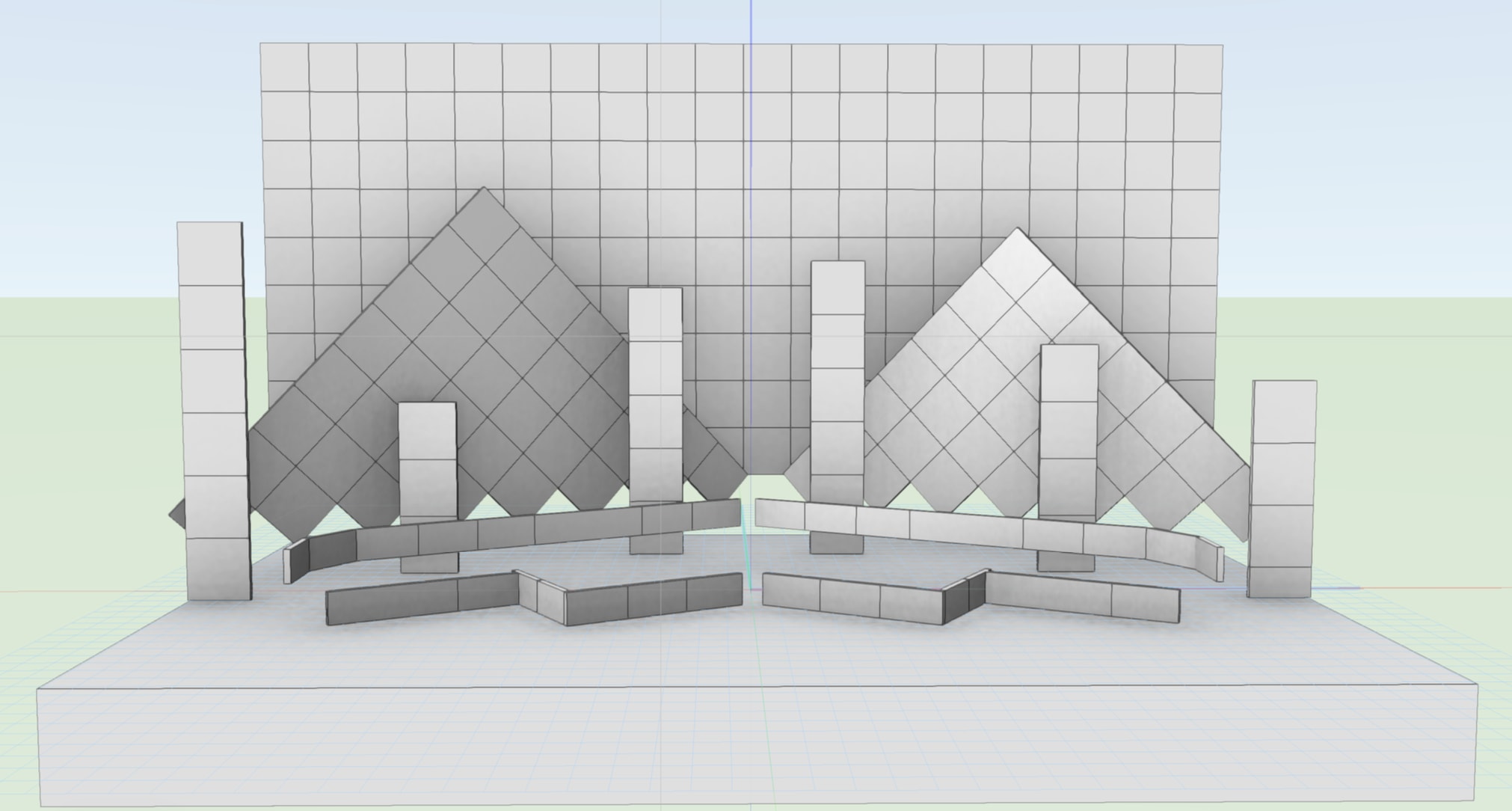
This was all drawn, as ever, with Vectorworks Spotlight.
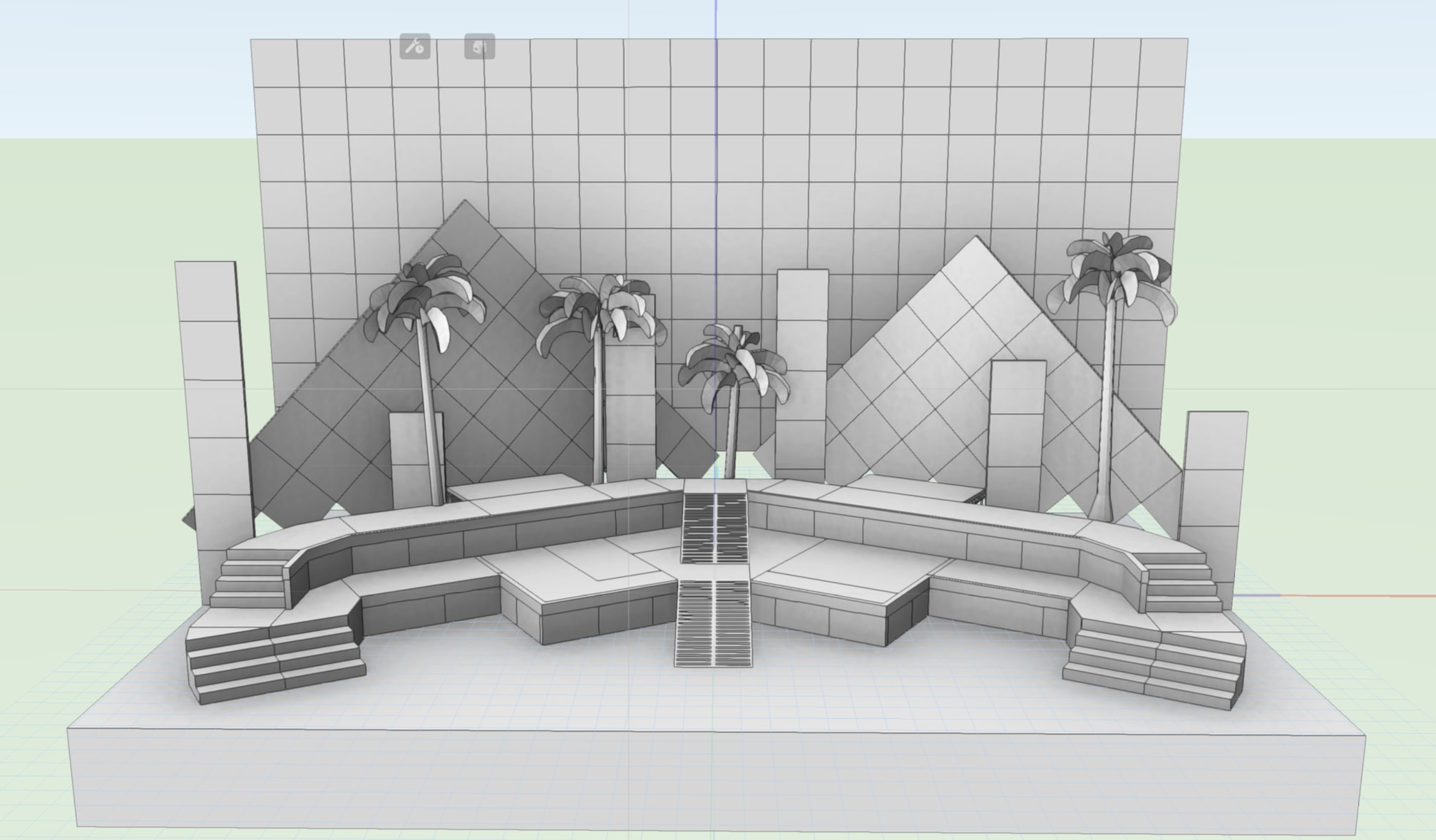
Next, the set. Based on the original sketch, I came up with this design. The set was rented for the tour, so it had to be made up of existing components from a rental company. The picture below was made up from 8’ x 4’, 4’ x 4’, and 8’ x 2’ decks with various-sized legs to achieve the different levels of the set. The trees were custom-built. However, in the end, we didn’t use them. The reason is that they’re very difficult to make look like anything but trees. We had so many different looks for the show, and the trees only really worked with some of them. It was easier to put them on the screens as content whenever we wanted them.
Next was to work out how to fly these scenic elements. These screens are heavy. A 20m x 12m screen weighs in at about 6 tons. The pyramids are approximately 2 tons each with their frames and cabling. The columns are about 500kg each. It all adds up. The only way to support these is to fly them on overhead trusses and lift them in sections. I came up with this.

So now we have the set and video worked out. It’s now time to find a place for the musicians.

Once the band has been placed and approved by the artist, I then need to work out how to fit the lighting fixtures amongst the musicians and the flown lighting above the band to fit in around the flown LED elements. Also, add in the sound and cable management requirements. Vectorworks has a very good built-in library of all these elements. Motors, truss, rigging, lighting, sound, and musical Instruments. All the components in this drawing are from the built-in Vectorworks libraries.
The last step is to place this model in a venue. I got the venue from Trimble, which is a 3D resource website of SketchUp drawings. I found a venue I wanted there and imported it into my drawing. Lined it up, and now the drawing is finished.

This is the result above. I added some 2D people into the drawing to create a crowd and added some side screens, and I’m done.
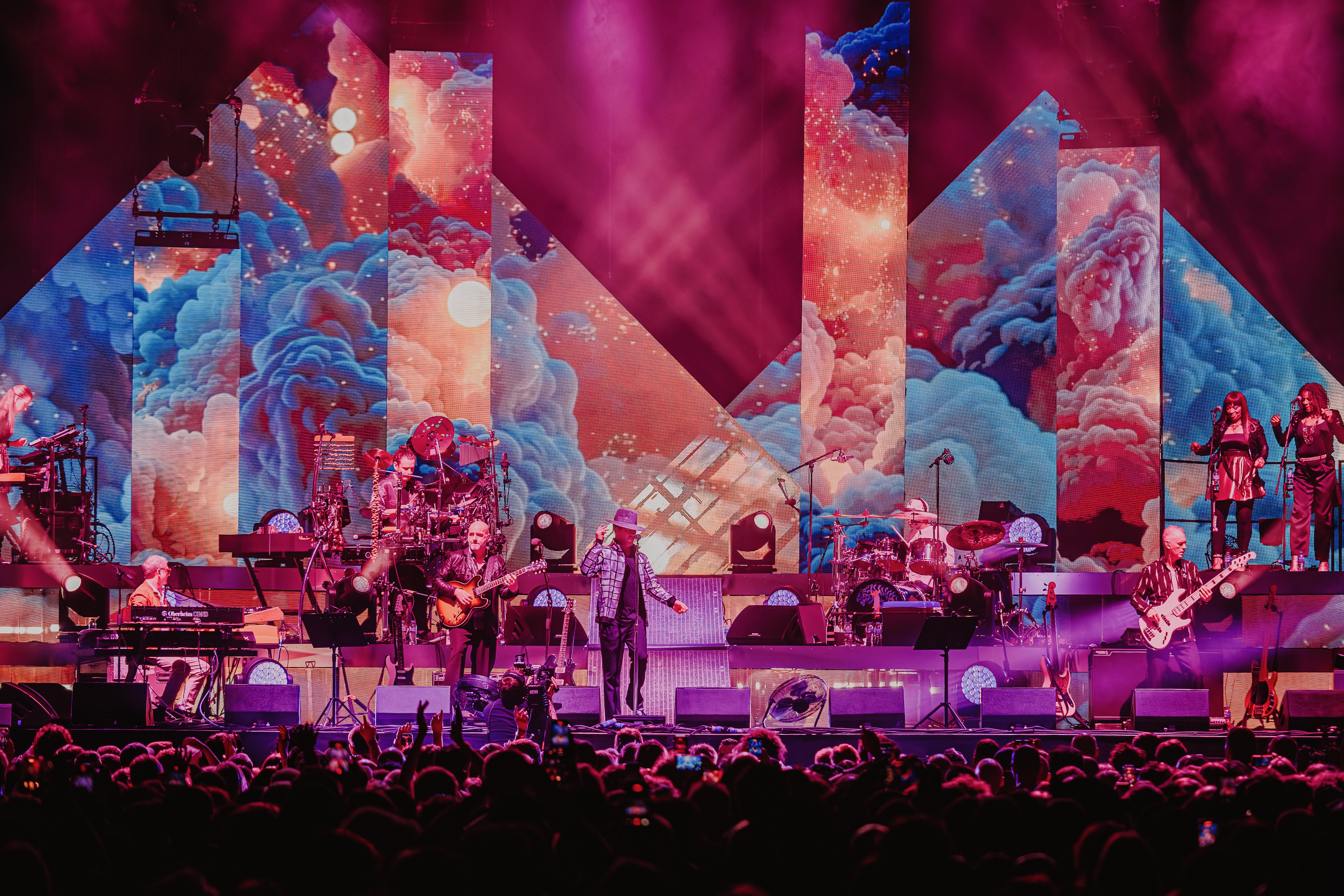
Below are some photos of the finished show. I think it came out well. Egyptian, cosmic, disco paradise.


WATCH VINCE FOSTER DESIGN
Check out Vince Foster’s arena design process with a free webinar.
All images courtesy of Vince Foster.
Stay in the know with the latest insights
Subscribers receive news, customer stories, success and learning tips, event information, and other important announcements from Vectorworks.
By submitting this form, you agree that Vectorworks, Inc. and its authorized partners may contact you in regards to news, offers, and the use of our software, services, and platforms. Learn more about our privacy practices and your data on our privacy page.*